
By the Sill Shade workroom team — 60+ years of measuring windows so the curtains fit the first time.
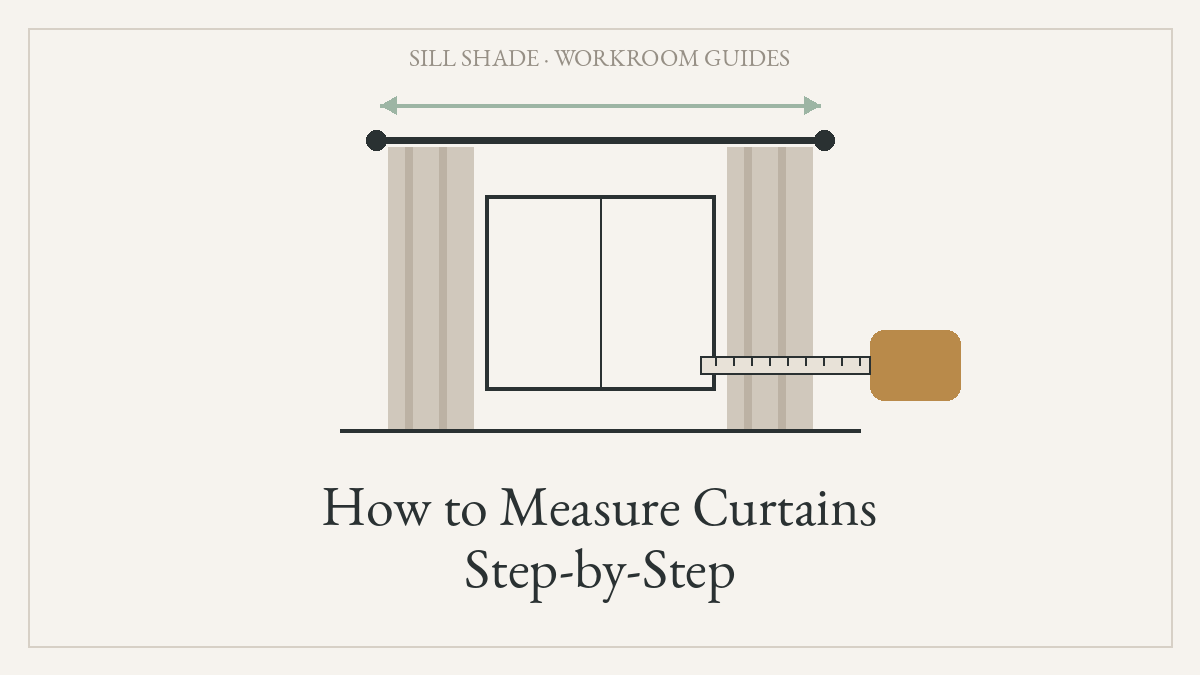
Measuring for curtains takes five minutes and two numbers: the width of your rod (not your window) and the distance from the rod to the floor. Get those two right, multiply the width by 2 to 2.5 for fullness, and you’ll never unbox a panel that hangs short or skimpy. Here is the exact process we use in customers’ homes, including the small adjustments for each header type that most guides skip.
What You Need
- A steel tape measure — cloth tapes stretch and lie
- A pencil and paper (or your phone)
- A step stool
- A helper for windows wider than 6 feet (optional but worth it)
Step 1: Decide the Rod Position First
Every curtain measurement starts from the rod — so fix its position before you measure anything. Our workroom defaults:
- Height: 4–6 inches above the window frame, or halfway between the frame and the ceiling. Higher makes the room look taller.
- Width: extend the rod 6–12 inches past the frame on each side. This lets open curtains stack against the wall instead of blocking glass — the room gets more daylight and the window looks bigger.
If the rod is already installed and you’re happy with it, skip ahead and measure from where it is.
Step 2: Measure Width (and Multiply for Fullness)
Measure the full length of the rod between the finials. (On a bay window, measure each segment separately — see our bay window guide.) This number — not the window width — is your starting point.
Then apply the fullness rule: total panel width = rod width × 2 to 2.5. Fabric needs to ripple; panels pulled flat like a bedsheet are the most common mistake we see after wrong length. Example: a 60-inch rod needs 120–150 inches of total fabric width — that’s two standard 54-inch panels at minimum, ideally two wider ones.
| Rod width | Total fabric width needed (2–2.5×) | Typical solution |
|---|---|---|
| 36″ | 72–90″ | Two 50–54″ panels |
| 60″ | 120–150″ | Two 54–72″ panels |
| 84″ | 168–210″ | Two 84–100″ panels, or three panels |
| 120″ (sliding door) | 240–300″ | Three to four wide panels |
Exception: sheers look best at 2.5–3× fullness; heavy blackout and velvet drapes can get away with 1.8–2×.
Step 3: Measure Length (Adjust for Your Header)
Measure from the top of the rod straight down to the floor. Then adjust for how the panel actually attaches, because each header style hangs from a different point:
| Header type | Where it hangs from | Adjustment to your rod-to-floor number |
|---|---|---|
| Rod pocket | Top of the rod | None — use the number as-is |
| Grommet | 1–1.5″ below the top of the rod | Panels sit lower — subtract nothing, but expect the hem ~1″ lower than a rod-pocket panel of the same size |
| Ring clips | Bottom of the clip | Subtract the clip drop (usually 1–2″) |
| Pinch pleat on hooks | Top of the rings | Measure from the eye of the ring to the floor |
| Tab top | Top of the rod (tabs wrap over) | None, but tabs add 1–3″ of visible rod |
Then pick your floor style: hem floating ⅜–½ inch off the floor (easiest to live with), just kissing the floor (most tailored), or puddling 1–6 inches (romantic, more maintenance). Our full curtain length guide covers all three, plus every standard panel size, if you haven’t chosen yet. If you would rather look up a size than measure from scratch, our standard curtain sizes chart lists every ready-made drop and width.
Step 4: Measure in Three Spots
Measure rod-to-floor at the left, center, and right of the window. In 60 years of installations we can count the perfectly level floors we’ve met on one hand. If the numbers differ:
- For a floating hem, use the smallest number — no corner will drag.
- For a kissing hem, use the largest — no corner will hover.
Measuring for Sill-Length and Cafe Curtains
Kitchen and bathroom windows follow the same logic with different endpoints: measure from the rod to half an inch above the sill (sill length) or 4 inches below it (apron length). For cafe curtains, the rod usually sits halfway up the window and the panel just brushes the sill.
Inside Mount or Outside Mount
Before any tape comes out, decide whether the treatment sits inside the window recess or outside on the wall. It changes every number you are about to write down.

Outside mount is standard for curtains and drapes. You measure the frame, then add 8 to 12 inches on each side for the rod so the panels stack on wall rather than glass, and you measure length from the rod ring to the floor.
Inside mount is standard for blinds, shades, and cafe curtains. You measure the recess itself at three points, use the narrowest, and deduct about a quarter inch for clearance. There is no adding — every extra inch is a fitting problem rather than a styling choice. The slatted-side version of this decision has its own routine — see how to measure for blinds.
Getting this backwards is the most expensive measuring mistake there is, because an outside-mount number ordered as an inside-mount product will not physically fit. The cafe-rod version of the same decision, with the numbers, is in cafe curtain rods.
Measuring for Drapes vs Curtains
The tape measure does not change. The allowances do.
Curtains are usually unlined or lightly lined, hang from a rod pocket or grommets, and take about two times the rod width in fabric. Drapes are lined, often interlined, carry a workroom heading, and want two to two and a half times the width to pleat properly. A lined drape also needs a return — the few inches of fabric that turn back to the wall at each end — which a flat curtain panel does not have.
So for the same window, a drape order is wider and longer than a curtain order. Add 3 to 4 inches per side for returns, and add an inch of length if the heading sits above the ring rather than on it. The full comparison is in curtains vs drapes.
When the Window Is Not Square
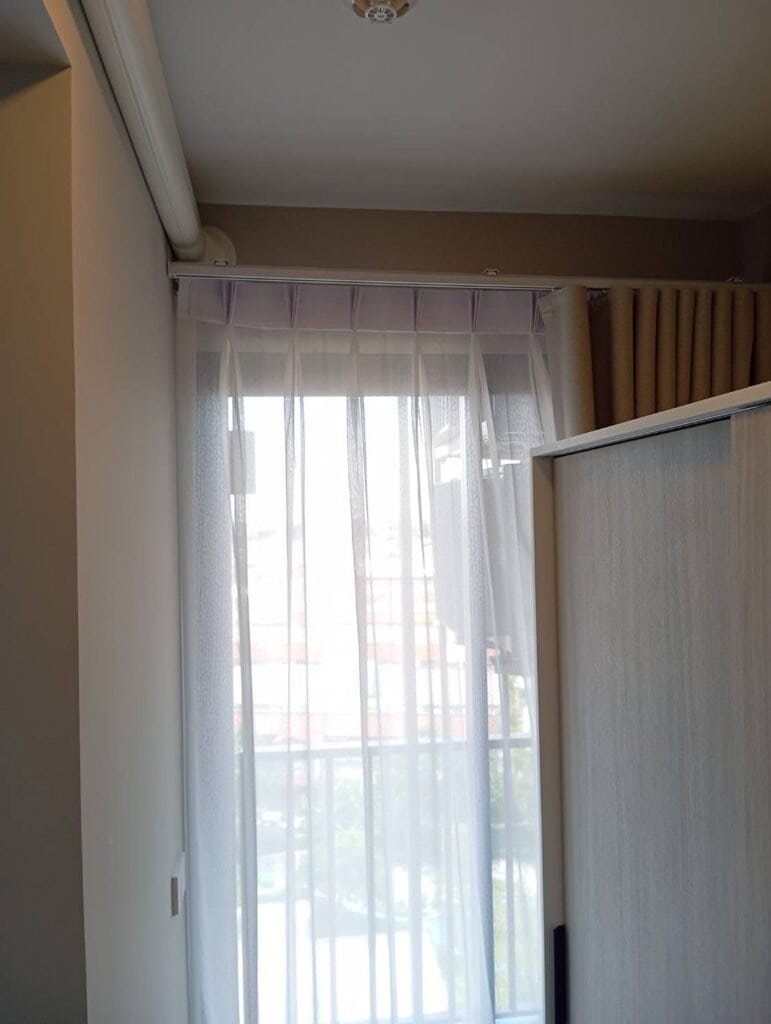
Very few are, and older houses are worse than new ones.
That is why Step 4 says measure in three spots. For an outside mount the variation rarely matters, because the fabric covers the wall either way. For an inside mount it decides whether the product fits at all: always use the smallest of the three widths, and the shortest of the three drops.
If the difference between top and bottom is more than about half an inch, an inside mount will show a visible wedge of daylight down one side. On those windows we move to an outside mount and let the fabric hide the problem — which is a fix, not a compromise.
4 Measuring Mistakes That Ruin Good Curtains
- Measuring the window instead of the rod. The window’s width is almost irrelevant — the rod decides everything.
- Measuring length before the rod position is final. Moving the rod up 3 inches after buying panels means every panel is now 3 inches short.
- Ignoring fullness. One 54-inch panel on a 60-inch rod will always look starved, no matter how beautiful the fabric.
- Trusting one measurement. Floors and ceilings are never as level as they look.
Measuring FAQ
Do I measure curtains from the top or bottom of the rod?
From the top of the rod for rod-pocket, tab-top, and back-tab panels. For ring clips, measure from the bottom of the clip; for grommets, remember the fabric tops out about an inch below the rod’s top.
How much wider than the window should curtains be?
The rod should extend 6–12 inches past the frame per side, and total fabric should be 2 to 2.5 times the rod width.
What if my measurement lands between two standard sizes?
Size up and hem, or size up and let it slightly puddle. A too-long panel is fixable in twenty minutes; a too-short one is fixable only by the store’s return desk.
How do you measure a window for curtains?
Measure the frame width, add 8 to 12 inches each side for the rod, then measure from where the rod will sit down to the floor. Take both numbers in three places and use the smallest width and the shortest drop.
How do I measure for curtains and drapes differently?
Same measurements, different allowances. Drapes need more width for pleating (2 to 2.5 times the rod) plus 3 to 4 inches per side for returns. Curtains need about 2 times the rod and no return.
Do I measure the window or the rod?
The rod, for length. The window, for deciding where the rod goes. Panel length always runs from the top of the ring to the floor, never from the top of the window frame.
Should I measure before or after buying the rod?
Decide the rod position first, fit the rod if you can, then measure. Measuring to a rod that does not exist yet is how people end up between two standard sizes.
How much wider should curtains be than the window?
The rod should extend 8 to 12 inches past the frame on each side. The fabric itself should total at least twice the rod width so the panels look full rather than stretched.
Next step: with your numbers in hand, see our complete curtain length guide to pick the right panel size, or browse all our curtain guides.