A roller shade is the simplest window covering ever built: a tube, a panel of fabric, and a spring or chain to move it. That simplicity is why it is the best-selling shade in America. One spec decides almost everything: the fabric. Choose the opacity right and a roller is the cheapest good decision on the whole window aisle. Choose it wrong and you will learn why bedrooms complain about stripes of morning light.
Our workroom has mounted rollers over every kind of glass for sixty-plus years. And yes, “roller blinds” and “roller shades” are the same product. The fabric makes it a shade, whatever the store sign says. This is how we spec them.
The Fabric Is the Whole Decision
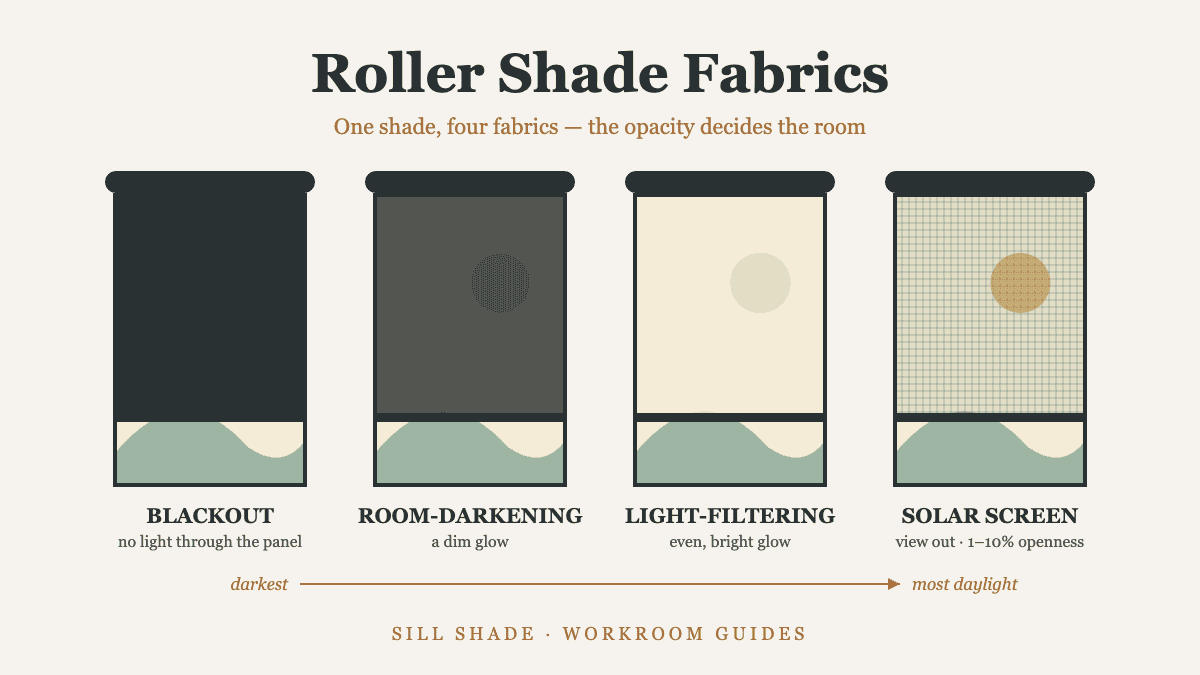
| Fabric | What gets through | Privacy | Where it belongs |
|---|---|---|---|
| Blackout | Nothing through the panel | Total, day and night | Bedrooms, media rooms, shift workers |
| Room-darkening | A dim glow | Full silhouette privacy | Bedrooms that like a soft morning |
| Light-filtering | Even, bright glow | Daytime yes, lamplight silhouettes at night | Living rooms, kitchens |
| Solar screen | View out, glare down | Daytime one-way only | West glass, offices, view rooms |
Solar screens carry one more number worth knowing: openness, the percentage of the weave that is actually hole. A 1 to 3% screen kills glare and keeps the most privacy, 5% is the everyday compromise, and 10% is for rooms where the view is the point. The rule of thumb from our install ladder: the better your view, the higher the openness you will forgive.
The Light Gap Nobody Mentions in the Showroom
On every roller, the fabric is narrower than the fitting. The brackets and mechanism eat roughly 1 1/8 to 1 3/8 inches of the width you ordered. Inside-mount a roller in a bedroom and you get two bright stripes down the recess at sunrise, guaranteed, even with blackout cloth. The fixes, in order of seriousness: mount outside the frame with 3 to 4 inches of overlap per side, add side channels that catch the edges, or layer drapery over the whole opening. The measuring routine, and the inside-versus-outside decision itself, follows the same rules as every hard treatment. They are laid out in how to measure for blinds.
Standard Roll or Reverse Roll
Small spec, real consequences. Standard roll drops the fabric off the back of the tube, close to the glass. It is the default, with the smallest light gap at the sides. Reverse roll brings the fabric over the front, which hides the bare tube and clears obstacles: crank handles, tile ledges, deep sills. If your window cranks open, say “reverse roll” before the order is cut. It is the difference between a shade that glides and one that slaps the handle every evening.
Chain, Spring, or Motor
The continuous chain loop is the standard control. Under the current window-covering safety standard (ANSI/WCMA A100.1, in force since June 2024) the loop has to run through a tension device anchored to the wall. With children in the house we skip the chain entirely and fit a cordless spring: pull the hem, let go, done. Battery tube motors have also become honestly cheap, and a roller is the easiest shade in the house to motorize. On tall or hard-to-reach glass we now quote the motor by default.
Open Roll or Cassette
A bare roller shows its tube and collects a line of dust along the top. Fine in a garage, less fine over a sofa. A cassette (a fitted headbox) or a fascia (a clean face panel) finishes the top for a modest upcharge, and it is the single cheapest way to make a budget shade read custom.
Where Rollers Win
Price, first and honestly. Nothing custom costs less per window. Minimal looks: a lowered roller is one flat plane, the least busy visual in the whole category. Wet rooms: vinyl and coated fabrics wipe clean, which makes rollers and faux-wood blinds the two survivors in kitchens and baths. And layering: a blackout roller against the glass with curtains in front is our standard bedroom recipe. The roller does the darkness and the fabric does the beauty. The drapery half of that recipe is in blackout curtains for the bedroom.

Where They Lose
Insulation: a single skin of fabric does almost nothing against a cold pane. If the complaint is temperature, the honeycomb construction wins by a distance, and we wrote exactly why in our cellular shades guide. Side light, as above. The gap is structural, not a defect. And wind: an open window turns a lowered roller into a slow drum. Hem weights help, and side channels cure it. If you are still deciding across the whole soft family, the seven-way comparison is in the types of window shades.
Care and Lifespan
Wipe coated fabrics with a damp cloth and vacuum woven ones with the brush head. Dust the tube line twice a year. When a spring roller stops holding position, the spring wants re-tensioning, a ten-minute job with the shade off the brackets. Do not reorder over it. Chains and clutches are replaceable parts. Sun fade takes the fabric before the mechanism dies. South and west windows show it first, in five to eight years.
What Rollers Cost, Honestly
The value leader of the shade world. The price climbs with fabric grade, cassette, and motor, in that order, and even fully loaded it usually undercuts a custom roman by half. When a whole house needs covering on a real budget, rollers on the secondary windows and better shades where guests sit is the split we quote most.
Roller Shades FAQ
Are roller shades and roller blinds the same thing?
Yes. Identical product, two names. “Roller blinds” is common in Britain and across much of the internet. US stores file them under shades because the working part is a soft fabric panel.
Do blackout roller shades block all light?
The fabric itself blocks everything, but the fitting leaves roughly half an inch to three-quarters of an inch of exposed recess per side on an inside mount. For a truly dark room, mount outside the frame with generous overlap, add side channels, or layer curtains over the shade.
What openness should a solar shade be?
1 to 3% for serious glare and the most daytime privacy, 5% for the everyday balance, 10% where the view matters more than the glare. Remember that all solar screens go see-through at night with the lights on.
Can you use roller shades in a bedroom?
Yes, with blackout fabric and either an outside mount with 3 to 4 inches of overlap per side or side channels. An inside-mounted roller alone will stripe the walls with morning light at the edges.
How long do roller shades last?
Five to ten years in daily use. Fabric fade on hot glass ends them more often than the mechanism does. Springs re-tension and clutches replace in minutes.
Pick the fabric, respect the light gap, and finish the top. That is most of the craft of a roller. Compare it against its cousins in the types of window shades, and browse everything we have written on this wing of the window in our blinds & shades guides.