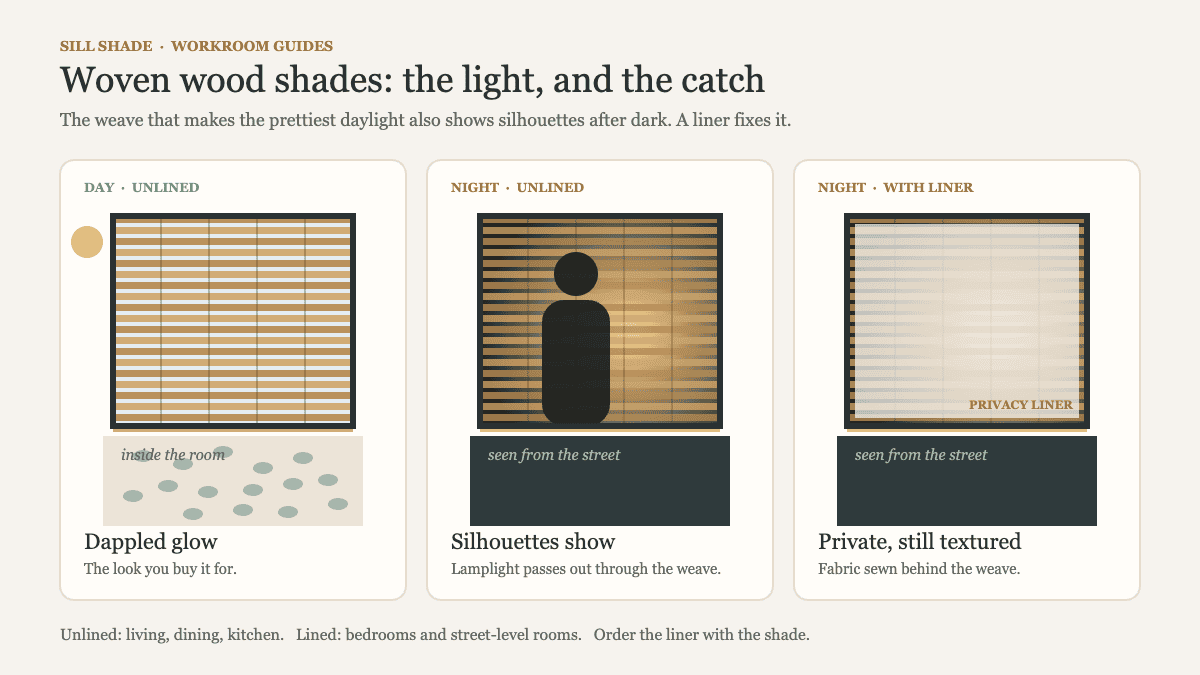
Woven wood shades (bamboo shades, matchstick blinds, grass shades, all one family) are panels of natural bamboo, reeds and grasses woven into a mat that folds or rolls up the window. They are the only covering people buy purely for texture. Nothing else puts that much organic warmth on a pane of glass for the money. They also carry one catch that decides every order: an unlined weave is a screen, not a wall. Light comes through, and at night so do silhouettes.
Our workroom has hung woven woods through every wave of the trend, and the current one (organic modern, japandi, coastal) is the strongest we have seen. This is what the material actually does.
What They Are Made Of
Thin bamboo slats, whole reeds, jute, and woven grasses, held by cotton or jute cording and combed into patterns that range from tight matchstick rows to loose, knotty weaves. Tones run from pale honey to smoked espresso. The variation is the point. No two panels repeat exactly, which is why the material photographs like furniture instead of hardware.
The Light Is the Look, and the Catch
Daylight through a woven wood arrives dappled, the way it comes through a straw hat. It is the prettiest light in the shade world, and the reason designers reach for them. The same weave works against you after dark: lamplight passes outward, and a person against the light reads as a silhouette from the street. Unlined woven woods belong in living rooms, dining rooms and kitchens, where nobody minds being a shadow. Bedrooms and street-level baths need the next section.
Liners Change the Job
Unlined is the full texture-and-glow experience. A privacy liner (a fabric layer sewn behind the weave) keeps the daytime look, kills the nighttime silhouette, and softens the dapple to a glow. A blackout liner turns the panel genuinely dark for sleeping, with the same edge caveat as every shade: light still slips at the sides of an inside mount, and the cure is an outside mount with overlap or a layer of drapery. Order the liner with the shade. Retrofitting one later costs nearly as much as the shade did.
Fold-Up or Roll-Up
Most woven woods operate like a roman: the mat gathers into soft horizontal folds as it rises, stacking 8 to 12 inches deep at the top. That is the same stack math as a fabric roman, and the same mechanics too, so our roman shades guide covers how the folds behave. The older roll-up style gathers the mat into a cigar roll lifted by exposed cords. Charming on a porch, less precise indoors. Either way, cordless lift is the standard under the ANSI/WCMA A100.1 safety standard (in force since June 2024), and it is the version we fit anywhere children live.

Where Woven Woods Win
Living rooms first, especially layered under curtains, where the weave gives the window a base of texture and the fabric does the softness. That pairing is half of what we install for the front of the house, and the drapery side of it is in living room curtains. They flatter big windows, warm up white-walled modern rooms, and hide architectural sins better than any flat panel. For presence per dollar, nothing on the aisle touches them.

Where They Lose
Humidity is the enemy. Steam swells and warps natural fiber, and a bathroom woven wood grows mildew spots by year two. Use faux wood or a synthetic roller shade in wet rooms instead. The full match-up of materials to rooms is in blinds vs shades. True darkness needs the liner, always. Sun fades the honey tones over the years, fastest on south glass.
Order every window of a room in the same batch. Natural material varies by lot, and two orders a month apart can arrive a shade apart. You will see it every day.
Measuring Notes
Inside mounts want about two inches of usable depth. Because a woven edge is irregular by nature, its side gaps read slightly larger than a fabric shade’s, which is another vote for outside mounts on bedrooms. Width, height, depth, three measurements each, no self-deductions. The full routine is in how to measure for blinds.
Care
Vacuum with the brush head along the weave, monthly-ish. Compressed air clears the crevices once a season. Never wash with water: natural fiber swells and cords stain. A soft dry paintbrush gets the corners the vacuum misses. That is the whole regimen. Woven woods are low maintenance as long as they stay dry.
What They Cost, Honestly
Mid-range: above rollers, below custom romans. The liner is the main upcharge and usually the right one. Big-box bamboo shades in standard sizes are genuinely cheap and fine for standard openings. Custom earns its price on wide windows, liners, and getting a whole room cut from one batch.
Woven Wood & Bamboo Shades FAQ
Are bamboo shades private at night?
Unlined, no. With interior lights on, silhouettes read through the weave from outside. A privacy or blackout liner fixes it completely and is worth ordering with the shade for bedrooms and street-facing rooms.
Can you put woven wood shades in a bathroom?
We advise against it. Steam warps natural fiber and invites mildew in the weave. Faux wood blinds or a synthetic roller handle the moisture and keep a similar warmth.
Do bamboo shades block light?
Unlined, they filter it into a dappled glow instead of blocking it. A blackout liner makes the panel itself dark. Edges still leak on an inside mount, so bedrooms do best with an outside mount or layered curtains.
Should bamboo shades be inside or outside mount?
Inside mount shows off trim and needs about two inches of depth. Outside mount covers the weave’s naturally irregular edges and blocks more light. Bedrooms: outside. Living rooms with good trim: inside.
How do you clean woven wood shades?
Vacuum with a brush head, use compressed air in the crevices and a dry brush for corners, and never use water. Kept dry, the material outlasts most fabric shades.
Texture by day, a liner for the night, and never in a bathroom: that is the woven wood deal. See how the family compares in the types of window shades, and find every guide we have written in our blinds & shades guides.