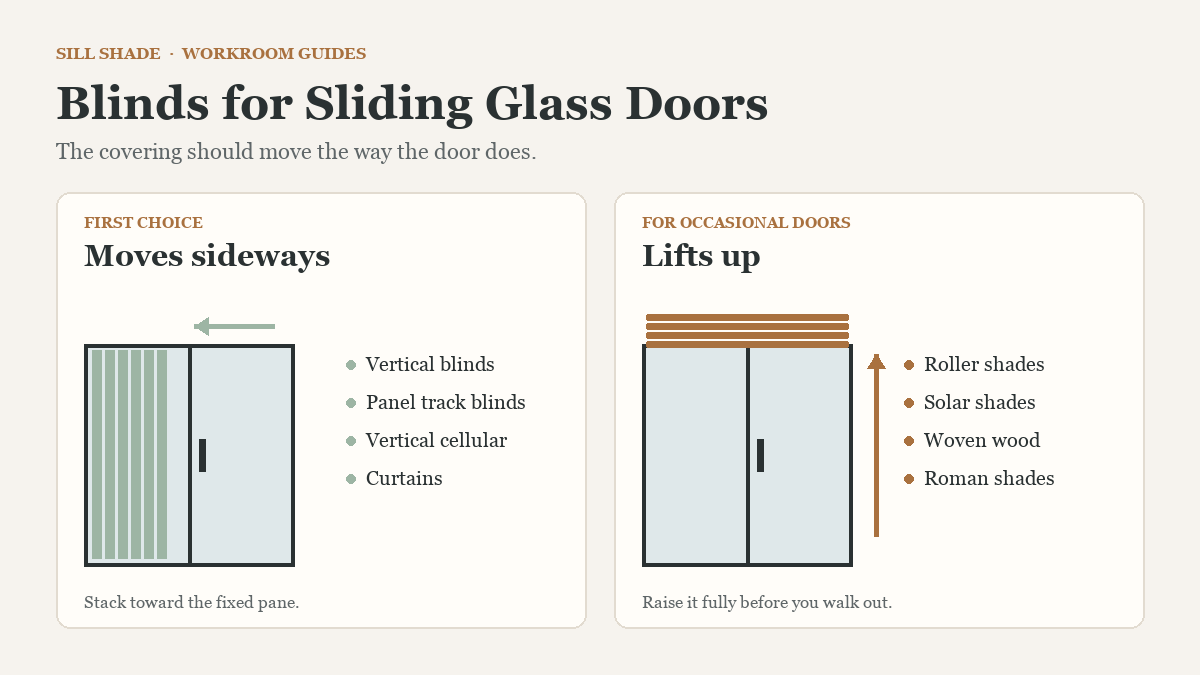
The best blinds for sliding glass doors move sideways, the way the door does. For most homes that means vertical blinds or panel track blinds. A shade that lifts can work too, but you have to raise it every time you walk out, so it suits a door you use a few times a day.
Our workroom treats a slider as a very wide window that people walk through. Two questions follow from that: which way the covering moves, and where it parks when the door is open.
The options at a glance
| Covering | Moves | Suits | Watch for |
|---|---|---|---|
| Vertical blinds | Sideways | Any slider; the usual builder choice | Light leaks at the edges |
| Panel track blinds | Sideways | Wide doors, a cleaner look | Panels do not tilt |
| Vertical cellular shades | Sideways | Doors that lose heat | Insulates less than a snug window fit |
| Roller or solar shades | Up | Glare control on a door used a few times a day | Raising it for every trip |
| Woven wood or roman shades | Up | Texture on an occasional door | A deep stack above the door |
| Horizontal blinds | Up | Rarely a slider | Weight, and a blocked walkway |
| Curtains | Sideways | Softness and layering | Needs wall for the stack |
If you are choosing for the rest of the house as well, our guide to the types of blinds compares every slat and panel.
Vertical blinds
Vanes hang from a top track and traverse sideways, which is why vertical blinds are the classic answer for a sliding glass door. Tilt the vanes to steer daylight, or draw the whole blind off the glass in one pull.
The builder-grade version has earned its reputation. It looks institutional, and it leaks light at the edges. Fabric vanes look softer than vinyl ones.
Check the clearance before you order. The headrail sits roughly 1.5 inches deep, and the vanes need 3.5 to 4 inches to swing freely. Leave about half an inch above the floor so they do not drag.
Panel track blinds
Panel track blinds are wide, flat fabric panels, usually two to five of them, sliding on a multi-channel track. They are our preferred hard covering for patio doors. You get the same full traverse as a vertical blind with bigger, calmer surfaces, and the same track can work as a room divider.
The panels do not tilt. Light control comes from how far you slide them, so choose the fabric the way you would for a roller shade, by how much light it lets through.
Open panels park behind one another, so a four-panel track stacks to roughly a quarter of its width. Plan for that stack to sit over the fixed pane or on the wall beside the door.
Vertical cellular shades
A vertical cellular shade turns the honeycomb fabric on its side and runs it along a track. It is the one sideways-moving covering built to insulate, and a sliding door is one of the largest sheets of glass in a house.
Keep expectations modest. Cellular shades insulate best when they fit tight inside a recess. A door covering hangs proud of the frame, where air can move around it.
Shades that lift
Roller, solar, roman and woven wood shades all go up, and a sliding door needs them all the way up before anyone walks through. On a balcony door you open a few times a day, that is a fair trade for a cleaner look.

Mount height decides whether this works. A woven wood or roman shade stacks 8 to 12 inches deep when raised, so the headrail has to sit high enough for that stack to clear the top of the door. A roller takes the least room, because the fabric winds onto its tube.
On a door the family uses all day, we would split the covering into two shades, one over each door panel. You raise only the one over the sliding panel. The cost is a thin line of light where the two shades meet.

For west-facing glass, a solar shade cuts glare and keeps the view. Reverse roll helps on a slider, because the fabric drops in front of the tube and clears the door handle.
Why horizontal blinds rarely suit a slider
A horizontal blind blocks the walkway until it is fully raised, and a slider is wide. Past about 6 feet, a faux wood blind is already a two-hand lift, and many sliding doors are that wide or wider.
If you want the slatted look anyway, real wood is the lighter slat. Our guide to wood vs faux wood blinds covers the weight question.
Which side should it stack?
Stack the covering toward the fixed pane. It then parks over glass that never opens, and the walkway stays clear. Check that the open stack does not cover the handle or sit in the door’s travel path.
Before you order, stand inside and note which panel slides and where the handle sits. Draw direction is part of the order, so decide it while you are standing at the door.
Measuring notes
Most sliders take an outside mount. Check how far the handle projects from the glass, because the covering has to hang in front of it.
For width, add 3 to 4 inches on each side of the opening so the covering overlaps the wall. Start about 3 inches above the opening to give the headrail room, or higher for a shade with a deep stack. A standard sliding door is 80 inches tall, and a vertical blind or panel track should stop about half an inch above the floor.
The full routine is in our guide on how to measure for blinds.
Cords, wands and children
A sliding door covering hangs to the floor, where small children play. The US Consumer Product Safety Commission says the safest option when young children are present is to go cordless. Vertical blinds and panel tracks can be ordered with a wand in place of a cord, and cordless lift is the standard for shades under ANSI/WCMA A100.1 (in force since June 2024).
Or skip blinds for curtains
Curtains also move sideways, and they bring a softness no hard covering has. They need wall beside the door for the stack. The lengths, the rod width and the stack-back math are in our guide to sliding glass door curtains.
Blinds for sliding glass doors FAQ
What are the best blinds for sliding glass doors?
Vertical blinds or panel track blinds. Both move sideways with the door and clear the doorway completely when open.
Can you put horizontal blinds on a sliding glass door?
You can, but the blind blocks the walkway until it is fully raised, and a blind that wide is heavy to lift. We would choose a covering that moves sideways.
Are panel track blinds better than vertical blinds?
Panel tracks give bigger, calmer surfaces with the same full traverse. Vertical blinds can tilt to steer light, which panels cannot. Choose by whether you want that tilt.
Which side should blinds stack on a sliding door?
Toward the fixed pane, so the open stack sits over glass that never opens and the walkway stays clear.
Can you use roller shades on a sliding glass door?
Yes, on a door you open a few times a day. Mount the shade high enough to clear the doorway when raised, or split it into two shades so the one over the sliding panel lifts alone.
The rest of our guides on hard window coverings are in the blinds & shades guides library.