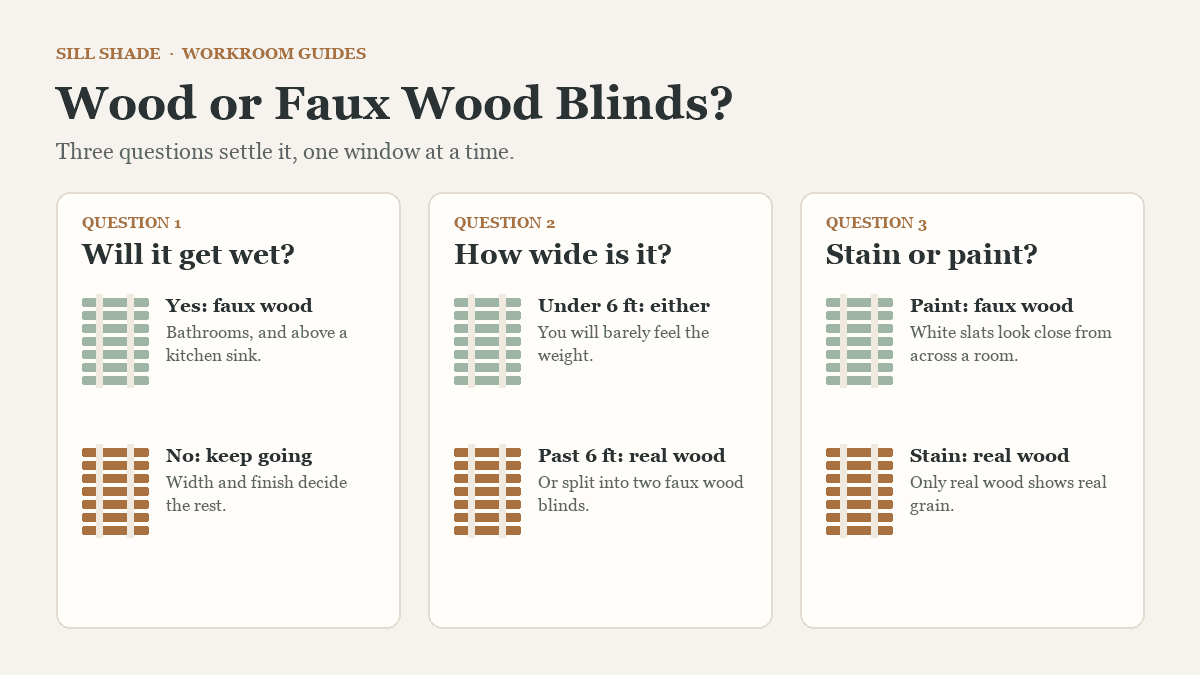
Faux wood is the right pick for most windows in a home, and for every window that gets wet. Real wood earns its higher price on wide windows and anywhere you want to see stained grain. Three questions settle wood vs faux wood blinds for any window: will it get wet, how wide is it, and will the finish be paint or stain?
Our workroom has fit both for years, and we ask these questions one window at a time. A kitchen and a living room can get different answers, and the same house can use both slats without looking odd.
What each slat is made of
Real wood blinds are usually basswood, cut into 2 or 2½-inch slats. Each slat has its own grain, and the wood is light for its size.
Faux wood covers two main products. PVC slats are solid plastic. Composite slats are a polymer blend, and the recipe varies by brand. Both are sold as faux wood, so read the spec before you compare two prices.
| What matters | Real wood | Faux wood |
|---|---|---|
| Slat | Basswood, usually 2 or 2½ in. | PVC or composite |
| Weight | Lighter | Heavier, and you feel it past about 6 ft wide |
| Steam and water | Warps and yellows | Takes it without damage |
| Look | Real grain, the warmest blind | About 90 percent of the look |
| Cleaning | Dry dusting | Dusting, and it can be wiped wet |
| Price | Higher | Lower |
Question one: will the window get wet?
Water comes first because it can rule out real wood before looks or price matter. Steam warps and yellows real wood within a couple of years. We never put it in a bathroom or above a kitchen sink, and we treat any other window that catches steam the same way.
Faux wood takes moisture without damage and wipes clean, which makes it our choice for kitchens and bathrooms. We also use it anywhere kids will handle the slats.

The window above the sink is the one people talk themselves into. It looks dry most of the day, so they pick real wood for the look. Every sink of hot water steams those slats, and a warped slat cannot be fixed.
Question two: how wide is the window?
Faux wood is the heavier slat. Real wood holds tiny air pockets, while PVC is solid all the way through. On a small window you will not notice the difference. On a wide one, you lift every slat at once.
Past about 6 feet wide, a faux wood blind becomes a two-hand lift. We either split that window into two blinds or use real wood. A tall window adds slats, so height counts as well.
Splitting has its own cost: a thin line of light where the two blinds meet. That line is easy to live with in a living room and less welcome in a bedroom.

Either way, cordless lift is the standard under ANSI/WCMA A100.1 (in force since June 2024), and it is what we fit anywhere children live.
Question three: stain or paint?
A stain sits in the grain, so real wood shows it and faux wood can only imitate it. If a stained finish is the reason you want wood blinds, buy real wood.
Paint covers the grain. From across a room, a white painted wood blind and a white faux wood blind are hard to tell apart, so the extra money buys a lighter blind and little else. For a white blind on a window under 6 feet wide, we would keep the money.
Order a sample of each and hold them against your window trim in daylight. While you have them, look at the cloth tapes too. These are the wide ribbons you can see in both photos above. They hide the cord holes and add a stripe of color down the blind, so they change the look as much as the slat does.
What about sun and heat?
Retailers disagree here. Some warn that PVC can soften and lose shape where heat builds up against the glass, and that dark slats absorb more of it. Others sell the same slats for any window. We found no published test data either way, so we treat it as a warranty question. On a hot west-facing window, read the heat terms before you order dark PVC.
What they cost
One US dealer’s guide puts faux wood at about $150 to $400 per window and real wood at about $200 to $600, with faux wood usually 15 to 30 percent cheaper. Size, slat width and lift type will move both numbers, so price the same window both ways before you decide.
The saving adds up across a whole house. On a wide window you open every day, we would still not let it decide.
Which blind goes in which room
Run the three questions through a typical house and wood vs faux wood blinds splits like this.
| Room or window | Our pick | Why |
|---|---|---|
| Bathroom | Faux wood | Steam |
| Kitchen | Faux wood | Steam at the sink, and it wipes clean |
| Kids’ room | Faux wood | Small hands on the slats |
| Living room or office | Real wood, 2½-inch slats | The look, and more view when open |
| Bedroom | Either, with a blackout layer | Slats leak light at the edges |
| Window past 6 ft wide | Real wood, or two faux wood blinds | The weight of the lift |
Neither slat will darken a bedroom alone, because slats always leak light at the edges. Pair the blind with blackout curtains for the bedroom. If you are still weighing slats against fabric, blinds vs shades covers that choice, and types of window shades shows the fabric options.
Before you order
Horizontal blinds need more window depth than most coverings, because the slats tilt inside the recess. Check the depth before you commit to a 2½-inch slat, using our guide on how to measure for blinds. The wider slat gives you more view when open, and it needs that extra room to turn.
If neither slat feels right, aluminum and vertical blinds are compared in our guide to the types of blinds.
Wood vs faux wood blinds FAQ
Are faux wood blinds better than real wood?
For wet rooms and most white blinds, yes. Real wood is the better choice for wide windows and stained finishes.
What are faux wood blinds made of?
PVC, or a polymer composite whose recipe varies by brand.
Can you put wood blinds in a bathroom?
We do not. Steam warps and yellows real wood within a couple of years, so use faux wood in any bathroom.
Are faux wood blinds heavier than wood blinds?
Yes. You will feel it on windows past about 6 feet wide, where we split the window into two blinds or use real wood.
How do you clean wood and faux wood blinds?
Dust real wood dry, slat by slat. Faux wood can also be wiped with a damp cloth, which is one reason it suits kitchens and bathrooms.
Every guide we have written on this side of the window is in our blinds & shades guides.